
Emissions Overview
QUAI supply evolves according to a single transparent equation: Three major protocol milestones define QUAI’s hard-money supply trajectory:- Singularity Fork (March 2026,
go-quai v0.51.0): Permanently burned 1,667,159,984 QUAI (81.1% of future genesis unlocks) via a multilateral agreement between investors, Dominant Strategies, and the Quai Foundation, lowering the vested genesis baseline from 3,000,000,000 QUAI to 1,332,840,016 QUAI. - Polaris Fork (October 2026,
go-quai v0.57.0): Quai founders and the Dominant Strategies team permanently burned an additional 236,456,538 QUAI from their remaining future genesis allocations—bringing cumulative genesis burns to 1,903,616,522 QUAI (~1.90B) and cutting the adjusted genesis baseline to 1,096,383,478 QUAI. - Project SOAP (December 2025 – ongoing): Routes 100% of external merge-mined Proof-of-Work subsidies (BCH, LTC, DOGE, RVN) into continuous open-market QUAI buybacks that are 100% permanently burned—over 254.6M QUAI burned to date.
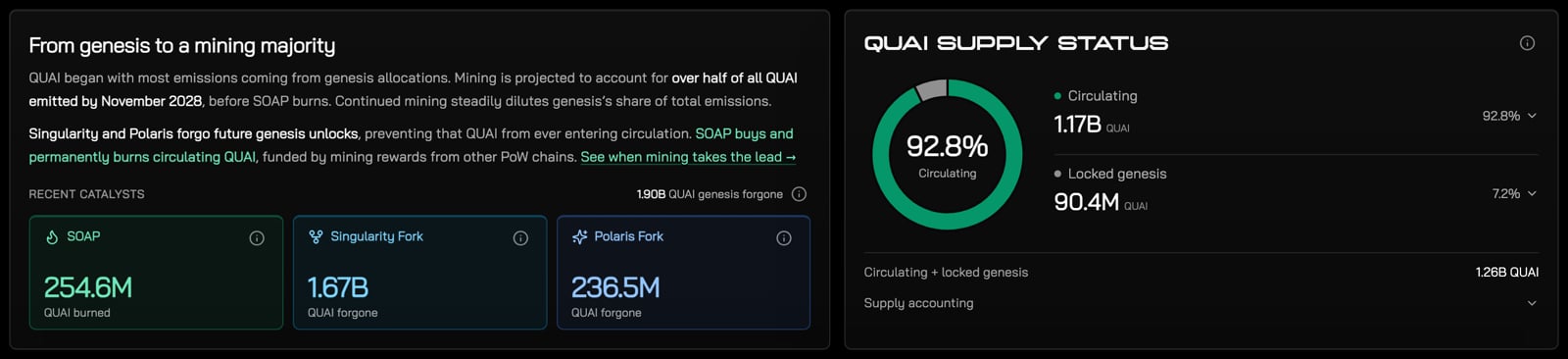
Live post-Polaris QUAI supply status and recent catalysts from supply.qu.ai (Nov 2026)
Live Supply Dashboard
Track real-time circulating supply, genesis burns, mining emissions, and unlock schedules on supply.qu.ai.
SOAP Burn Dashboard
Monitor live merge-mining subsidy inflows and cumulative QUAI buybacks and burns.
Burn Address on Explorer
Inspect permanently burned QUAI on-chain via explorer.qu.ai.
Post-Polaris Supply Snapshot
The Polaris Fork (activated October 13, 2026; unlock schedule effective after the October 30 cutoff) eliminated long-term insider overhang and accelerated QUAI’s transition into a mature, supply-constrained hard-money asset: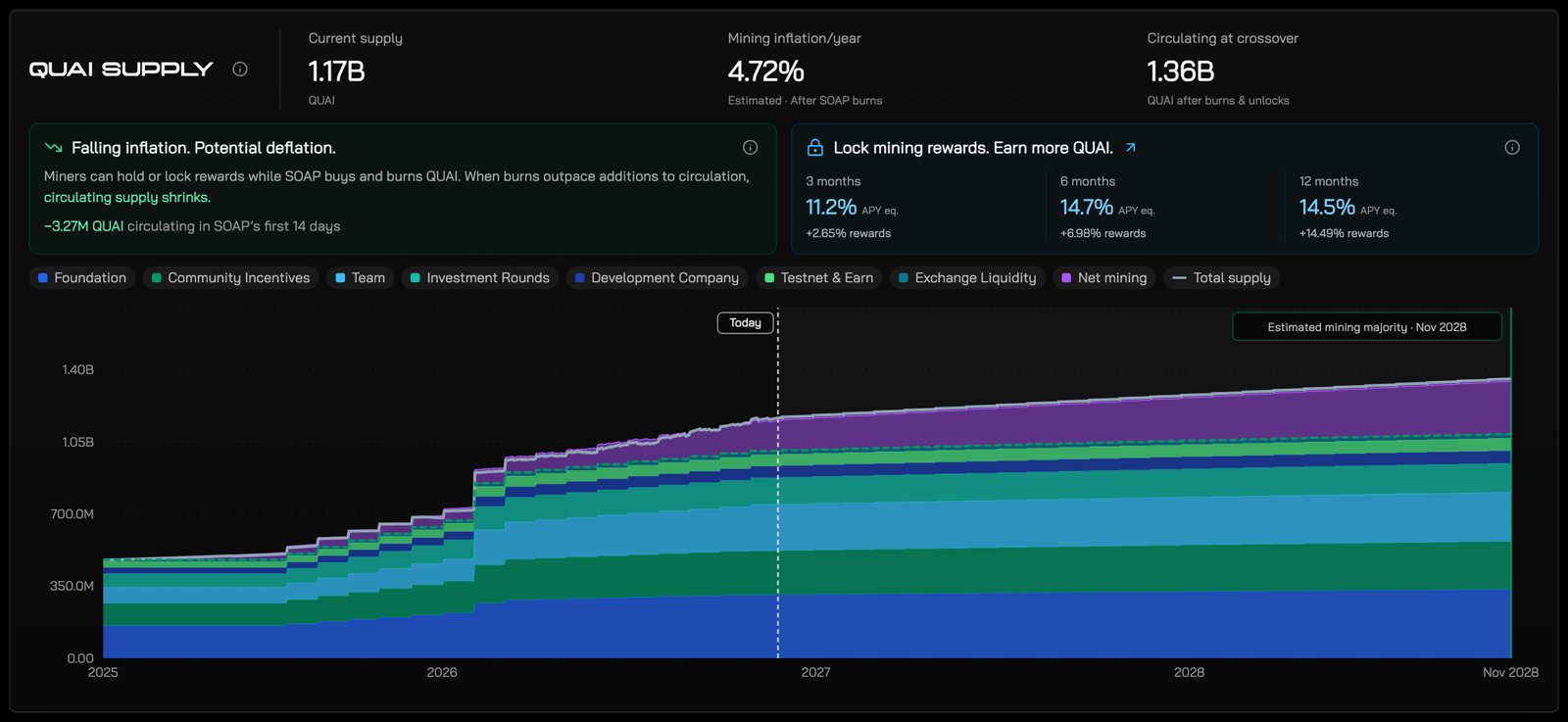
Post-Polaris QUAI supply trajectory through estimated mining majority in November 2028 (supply.qu.ai)
For real-time circulating supply, cumulative SOAP burns, and daily emission breakdowns, always refer to supply.qu.ai. For the full fork-by-fork breakdown, see Protocol Upgrades.
Rethinking Token Emissions
Traditional cryptocurrencies use fixed time-based emission schedules. Bitcoin’s 21 million cap is the best-known example. While predictable, rigid schedules cannot respond to changing demand or hashpower, which can amplify boom-bust cycles. For a store-of-value token, durable value creation requires supply growth to remain below network adoption growth. Rather than relying solely on arbitrary calendar cliffs, Quai combines:- Logarithmic mining emissions: QUAI block rewards scale inversely with network difficulty growth, naturally decelerating issuance as hashrate and adoption expand.
- Dual-token flexibility: Miners can elect to earn either QUAI (scarce store of value) or Qi (energy-backed flatcoin), dynamically balancing scarcity and payment liquidity.
- SOAP open-market burns: External Proof-of-Work subsidies continuously purchase and destroy circulating QUAI, creating a permanent demand-linked supply sink.
Network Value Theory & Emission Design
Network systems typically pass through two growth phases:- Early stage: Rapid expansion driven by network effects
- Mature stage: Steadier expansion driven by efficiency gains
- Adaptive supply: Protocol issuance responds directly to mining difficulty and demand.
- Efficient allocation: Capital and security rewards flow where they are most productive.
- Reduced supply shocks: Controlled, transparent emission curves without destabilizing release cliffs.
QUAI Emission Distribution & Inflation vs. Bitcoin
QUAI is designed to converge into a fair, mining-driven hard asset. With ~1.90 billion genesis tokens permanently burned across the Singularity and Polaris forks—and ~92.8% of supply already circulating—cumulative Proof-of-Work mining rewards are projected to surpass unlocked genesis allocations by November 2028 (~1.36B QUAI circulating at crossover) and reach ~62.6% of total emitted supply by the end of 2030 (before SOAP burns).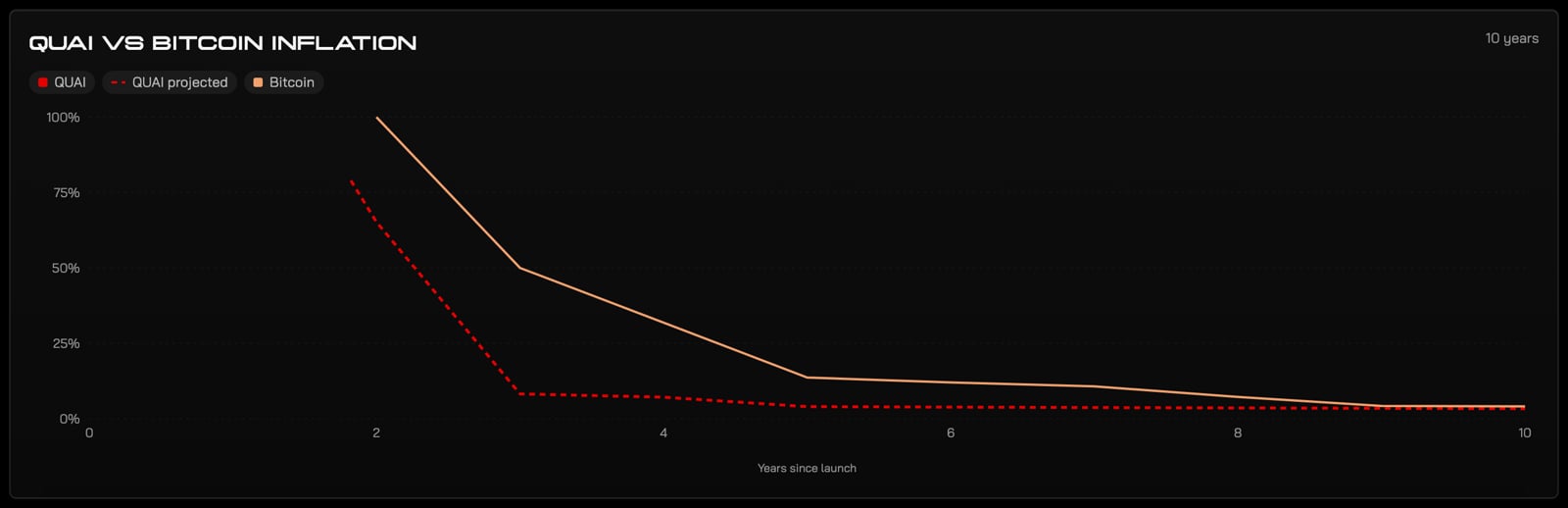
10-year inflation trajectory: QUAI (post-Polaris & SOAP) vs. Bitcoin (supply.qu.ai)
SOAP Buyback and Burn
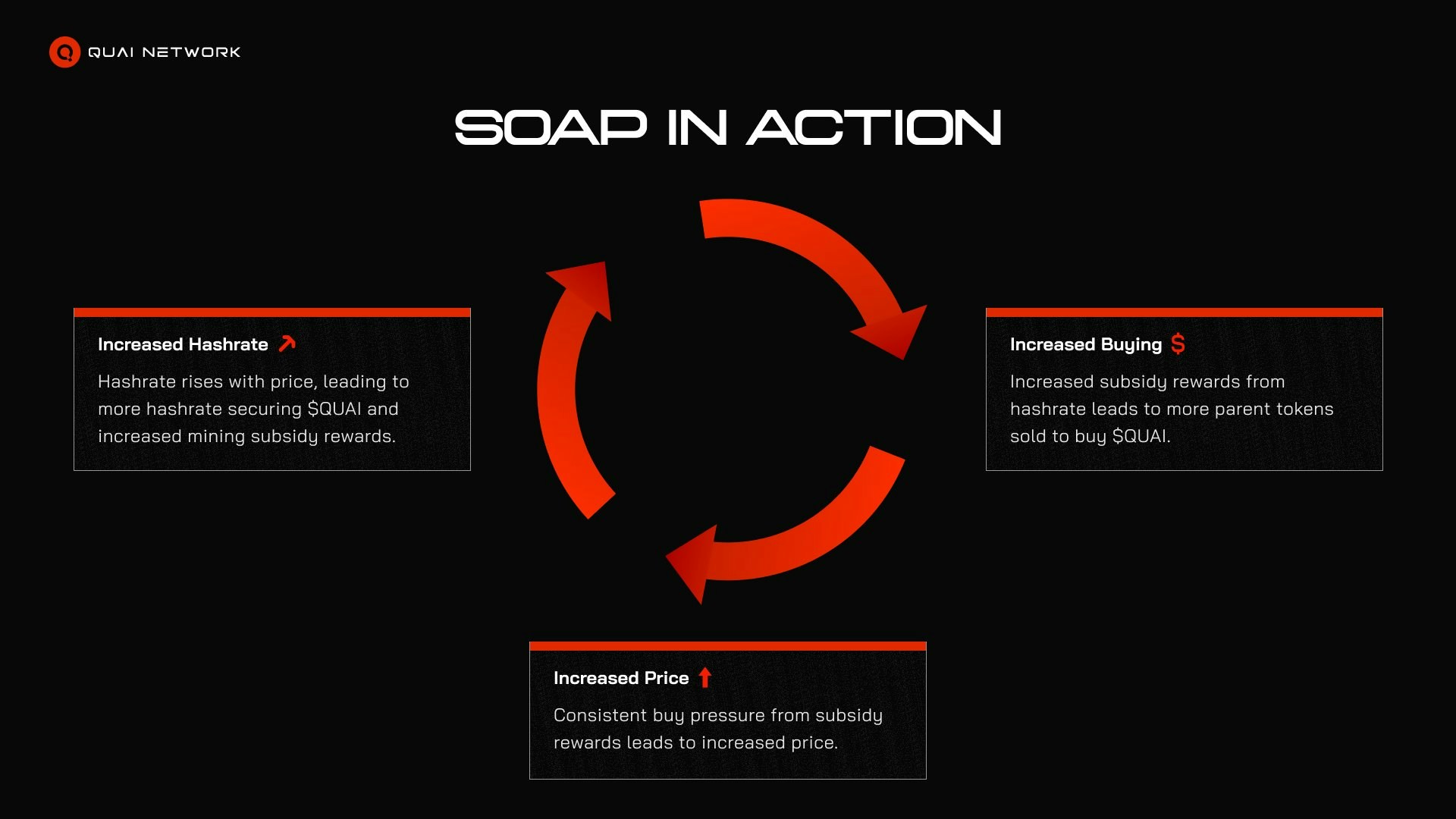
With Project SOAP active, merge-mining subsidies from external Proof-of-Work parent chains (BCH, LTC, DOGE, RVN) are routed at the protocol level via AuxPoW commitments to a protocol-controlled address, converted to QUAI on the open market, and 100% permanently burned. In practice:- External chain subsidies are captured at the protocol level through AuxPoW workshare commitments.
- Those subsidies continuously buy QUAI on the open market.
- 100% of purchased QUAI is sent to the burn address (
0x0050AF0000000000000000000000000000000000), permanently reducing circulating supply.
Historical Genesis Baseline (Pre-Singularity / Pre-Polaris)
Historical Genesis Baseline (Pre-Singularity / Pre-Polaris)
Before the Singularity Fork (March 2026) and Polaris Fork (October 2026), Quai launched with an initial vested genesis baseline of 3,000,000,000 QUAI. Through two protocol-level burns totaling 1,903,616,522 QUAI, that baseline was permanently reduced to 1,096,383,478 QUAI.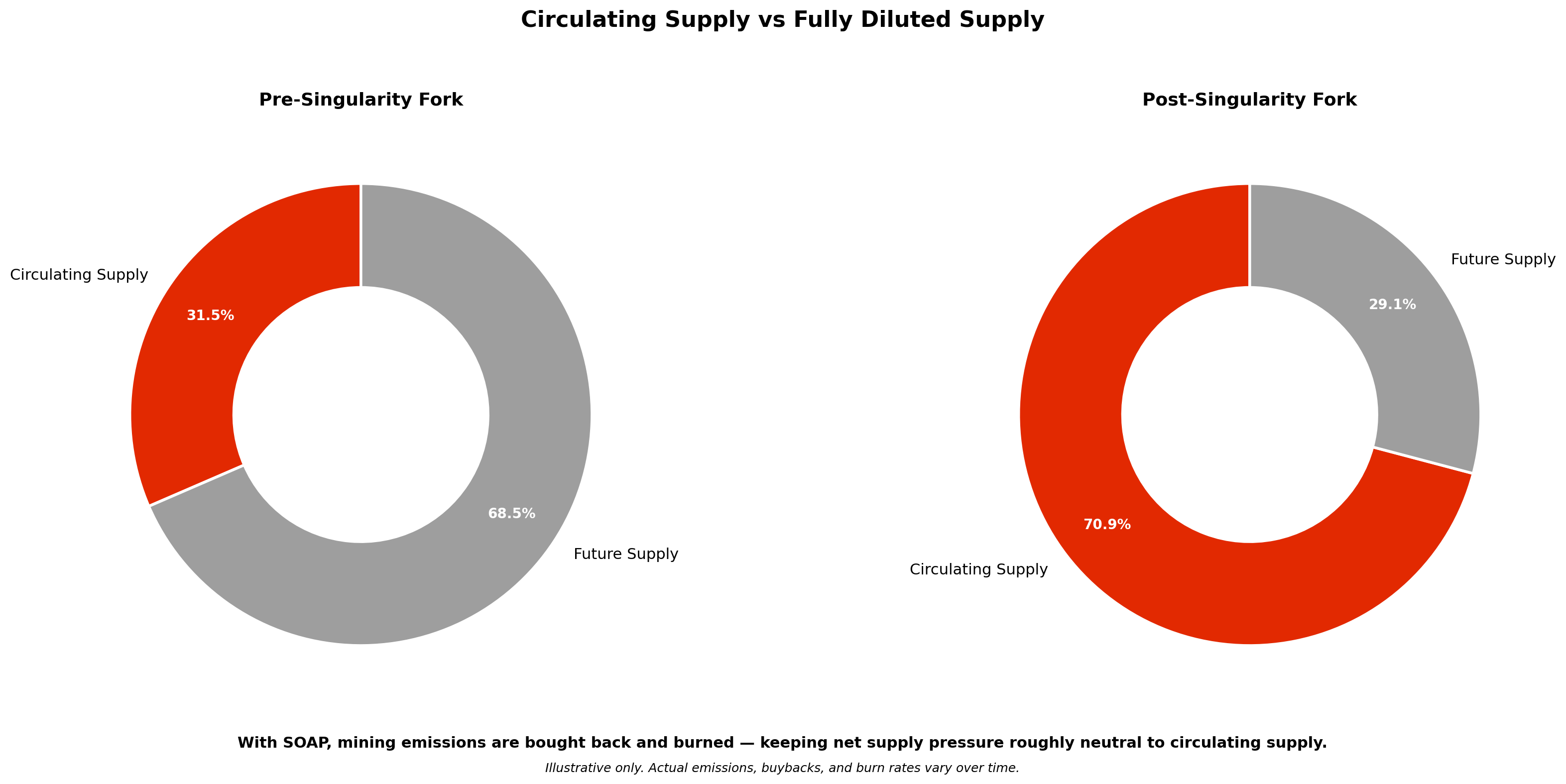
The chart above reflects the initial Singularity Fork reduction (3.00B → 1.33B). The subsequent Polaris Fork burned an additional 236,456,538 QUAI from remaining founder and Dominant Strategies unlocks, bringing the adjusted genesis baseline to 1,096,383,478 QUAI. See supply.qu.ai for live post-Polaris charts.
Original Launch Unlock Schedule (Superseded by Singularity & Polaris)
Emission Mechanics Deep Dive
Emission Mechanics Deep Dive
QUAI supply is governed by genesis unlocks, Proof-of-Work mining emissions, and SOAP buyback-and-burn flows.For deeper technical mechanics: